The Digital Insider: Securing the Agentic AI Workforce in 2026
AI agents are transforming the workplace. Learn the emerging security risks, governance challenges, and practical steps organisations should take in 2026.
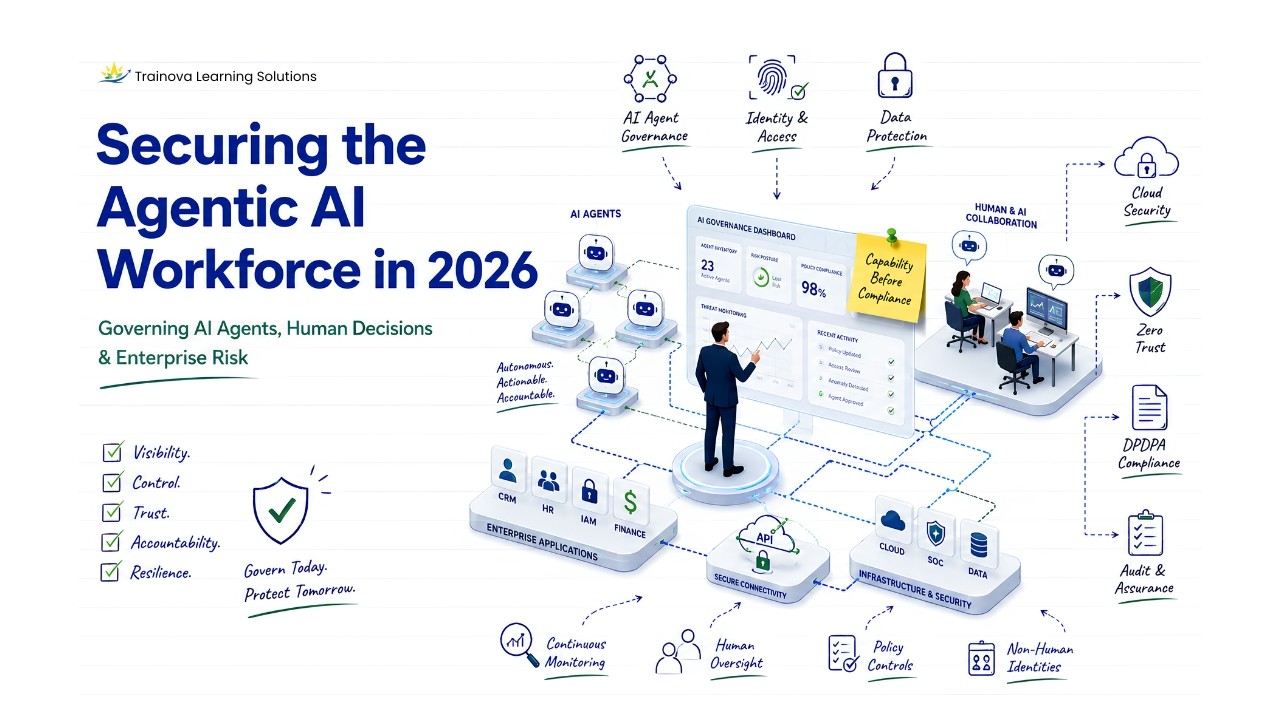
The AI Colleague Nobody Hired
There is a new member on most enterprise teams in 2026. It attends meetings, reads emails, submits purchase orders, queries databases, and interacts with APIs — all without a badge, a background check, or a single line in the HR system.
This is the AI agent: an autonomous software entity that doesn't just respond to prompts but actually executes tasks. And while business units have been quick to embrace them, security teams are only now waking up to a hard truth: your AI agents are behaving like digital insiders, and most organisations have no controls in place to govern them.
This is not a theoretical concern for 2027. It is the defining security challenge of right now.
From Chatbot to Co-Worker: What Changed
The shift happened quietly. Twelve months ago, most enterprise AI interactions were bounded — an employee typed a query, received a response, and decided what to do with it. The human remained in the loop.
Today, the architecture looks entirely different. Agentic AI systems can autonomously plan multi-step tasks, invoke tools, call APIs, write and execute code, and chain decisions across dozens of connected enterprise applications — all without a human approving each action.
According to a 2026 Dark Reading poll, 48% of security professionals now rank agentic AI as the top attack vector of the year, driven by the combination of rapid enterprise adoption, expanding non-human identities, and the fundamental mismatch between autonomous agent behaviour and legacy security models.
The number that should stop every CISO in their tracks: 40% of enterprise applications now embed AI agents. Most security teams don't know which ones. Most compliance frameworks haven't caught up. And most practitioners — including senior security engineers — were never trained to think about AI as an active participant in their threat landscape.
Why This Is Different from Shadow IT
Security leaders are tempted to frame agentic AI risk as the next chapter of Shadow IT — another case of employees bypassing procurement to use unauthorised tools. But this comparison misses something critical.
Traditional Shadow IT was passive. A rogue SaaS application stored data somewhere it shouldn't. The risk was bounded by access controls and data-at-rest policies.
Agentic AI is active. When an AI agent is compromised, it doesn't just store sensitive data — it acts on it. It can query restricted databases, initiate transactions, send emails impersonating executives, delete records, and exfiltrate information through legitimate-looking API calls. All of this can happen in milliseconds, at scale, and with the permissions of the user or system it is operating on behalf of.
Research from AGAT Software found that 82% of executives are confident their existing policies protect against unauthorised agent actions. The actual gap between that confidence and their real controls is the defining security blind spot of 2026.
Three Attack Vectors Your Team Is Probably Unprepared For
1. Prompt Injection: The Invisible Hijack
Unlike traditional software that executes structured code, AI agents are governed by natural language. This makes them uniquely vulnerable to prompt injection — where malicious instructions are embedded inside data sources the agent reads (a document, a webpage, an email), causing the agent to deviate from its intended task.
OWASP has flagged goal hijacking, tool misuse, and identity/privilege abuse as core threats for autonomous systems in 2026. A well-executed prompt injection doesn't look like an attack. It looks like the agent doing its job.
2. Privilege Escalation Through MCP Servers
The Model Context Protocol (MCP) is the open standard that allows AI agents to connect to backend data sources and tools. When an agent invokes an MCP server, it typically inherits that server's permissions. If those permissions are not tightly scoped, a low-privilege agent can be manipulated into accessing highly restricted systems — what security practitioners call a privilege escalation loop.
This is not a theoretical edge case. The SANS Institute has documented the "agent identity problem" extensively: AI agents lack the contextual judgment to refuse over-privileged access, and most enterprise MCP deployments have no monitoring at the tool invocation layer.
3. Identity Impersonation at Machine Speed
Advanced phishing campaigns in 2026 no longer send poorly crafted emails. They operate through agent-driven chatbots capable of holding convincing, contextually aware dialogue. A fully compromised internal agent can impersonate a CFO in internal systems, request urgent wire transfers, modify access permissions, and leave almost no traditional forensic trace.
This is the threat landscape that practitioners trained on perimeter defence and signature-based detection are completely unprepared to handle.
The Training Gap Is the Governance Gap
At Trainova Learning Solutions, we work with security teams across cybersecurity and IAM domains, and the pattern is consistent: organisations are investing in AI tools and AI certifications, but the two rarely connect to the actual work.
Generic AI certifications teach neural network architecture and model theory. What they don't teach is how to audit an agentic workflow, configure runtime governance for an MCP deployment, or detect a prompt injection in a production environment. The result is practitioners who can pass an exam but cannot defend the systems they are supposed to protect.
The problem isn't training. It's what happens after training — when the course ends and the engineer returns to an environment where the threat is active, the tooling is unfamiliar, and the playbook doesn't exist yet.
This is precisely the gap Trainova was built to close.
What AI-Ready Security Actually Looks Like
Defending an agentic enterprise requires a shift from perimeter thinking to execution-layer governance. Here is what organisations with mature practices are doing differently:
Inventory before governance. You cannot govern what you cannot see. The first step is a structured discovery of every AI agent operating in your environment — sanctioned or otherwise. This includes agents embedded in third-party SaaS tools, not just those your team explicitly deployed.
Treat agents like non-human identities. Every agent needs a unique identity, scoped permissions, and a defined behavioural boundary. Token management, rotation policies, and access reviews apply to agents just as they do to human users — arguably more so, given their speed of action.
Monitor at the tool invocation layer. Most security monitoring focuses on the model layer: which AI tools employees access. The real risk in 2026 is at the execution layer — what those agents do once they have access. Runtime monitoring of tool invocations is non-negotiable.
Build the attacker mindset, not just the defender checklist. The practitioners most effective at securing agentic systems are those who understand how to exploit them. Trainova's programmes are built around this principle: real-world simulation, practitioner-led instruction, and scenarios drawn from actual enterprise environments.
The Bottom Line for Security Leaders
The agentic AI workforce is already in your organisation. The question is not whether to permit it — that decision was made the moment your teams started using tools that embed autonomous agents. The question is whether your security practitioners have the capabilities to govern, monitor, and respond to what those agents do.
Generic training won't answer that question. Checkbox certifications won't answer it either.
What will: bespoke, practical capability building designed around your actual environment, your actual threat surface, and the skills your practitioners need to execute on day one — not in a test environment, but in the real world.
That is what Trainova delivers.
Ready to assess your team's AI security readiness? Book a no-obligation capability conversation with Trainova →
About Trainova Learning Solutions
Trainova bridges the gap between learning and real-world execution through consulting-led capability building. We work with security and identity teams across cybersecurity and IAM domains to design learning interventions aligned to actual business environments — not generic content. Our practitioner network connects organisations with experienced professionals matched to their exact domain requirements.
© 2026 Trainova Learning Solutions. Blog post for www.trainovalearning.com